Did you ever imagine living a life without smart phone, internet, laptop, Tv and all the electrical devices?
Well, I ditched away my smartphone, laptop and internet for 12 days and yet I still "ALIVE"!
Well, the story began with my internship with the Malaysian Nature Society (MNS) where I joined the MNS Hornbill Volunteer Program in Belum-Temengor Forest Complex.
 P/s: That was Elephant poops~~
Well, I ditched away my smartphone, laptop and internet for 12 days and yet I still "ALIVE"!
Well, the story began with my internship with the Malaysian Nature Society (MNS) where I joined the MNS Hornbill Volunteer Program in Belum-Temengor Forest Complex.

Belum Temengor Forest Complex is the second largest remaining block of unprotected rainforest in Peninsular Malaysia.
PS: It is approximately 130 million years old!!!!!
PS: It is approximately 130 million years old!!!!!

P/s: There are 10 species of Hornbill in Malaysia and all 10 of them can be found HERE!!!

During my internship with the Malaysian Nature Society, I joined this volunteer programme in the Belum –Temengor Forest Complex, Perak for 12 days.
We were here to monitor the Plain-pouched Hornbill as a part of a national
conservation effort where we help to conduct important daily flight census and collecting data.

To get into the Belum-Temengor Complex, we need to travel to Gerik town, Perak and from Gerik to Banding Jetty.
The Jetty is located below the bridge of East-West Highway.
Then from Banding Jetty, we traveled into the Kampung Tebang, Belum Temengor by boat.
Then from Banding Jetty, we traveled into the Kampung Tebang, Belum Temengor by boat.


The forest is flooded into a manmade lake for dam water supply.

We settled down in the
bamboo hut built by Orang Asli just beside the Temengor lake.

Breath taking scenery from the hut~


My bed.. Well... It was a volunteer program so we just slept on our sleeping bed...

Our food supplies for a week~


Hornbill census was conducted twice a day, once in the morning and once in the late afternoon.
This valuable information on population numbers will be used to advocate for the protection of Belum-Temengor, especially in addressing the logging threats.

Bird counting even during raining days...
Everyone in the counting group was ready with their binoculars at the birding site and waited for the Plain-pouched to come.
After a helicopter sound like was heard, Oh My God!!! It's the Plain-pounced flying above us!
The Helicopter sound was actually the flapping sound of their wings.
It was so amazing!!!!
Wait a minute, Don't Just Stand There!!! Quickly start counting!!!
Flock 1- 1,2,3,4,5,67...
Flock 2- 1,2,3,4,5,6,7,8...
My eyes get blur when so many of them flew together... @.@
But after some practice, you will get use to it and bacome good in counting too~

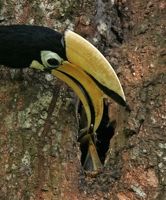
Say hello to Plain-pouched Hornbill~~
You can clearly see the colour of their pouch where blue is female while yellow is male~
P/s: This is a globally threatened bird where you can't see it in Borneo.

The most incredible scene of all was when hundreds of Plain-pouched Hornbill flew across the sky in V or U shape formation.
Beside counting, we also have activities during our free time.
We hiked around for birding, experiencing the Orang Asli life, and did some social work with them.

This Orang Asli lady demonstrated the traditional way in preparing Orang Asli dishes.

And she has a Rooster that act like dog!!!
The rooster in Kg Tebang will " crow" fiercely when strangers come near their owner's house!!!
And they can fly up to the tree tops and roof top to crow during the sunrise...
Then you will know there are how many of them actually around Temengor when all of them take turn to crow... @.@

Paip blowing demonstration by Orang Asli.
They claimed that there are no cure for the poison that applied on the dart..
So, becareful while handling!


Well, my favourite activity during my leisure time was "spying" on the life of Orang Asli~
Their kids were shy but they really have a different lifestyle from city kids.

They were free to play at all time and made themselves dirty all time.
This is what the city kids are not allowed to do...

We have to carry water from the lake up into the house for daily usage...
@.@

Too bad that I didn't manage to see the blooming Rafflesia... The flower was still in bud form..


Lastly, I really did enjoy the life living around the Orang Asli!
I got my chance in trying many new things here such as fishing, washing beside the lake and bathing beside the lake too!
But the best thing of all was enjoying the silent night with fireflies dancing around the lake under the starry night~
This is the magical moment that we will never experience in the city....
Planning to do something meaningful while having holiday?
Why not try enrolling yourself in a volunteering programme?
Why not enhancing your life experience while lending a hand in helping our mother earth?
For more information, visit http://mnshornbillvolunteerprogramme.wordpress.com/about-mns-hornbill-volunteer-programme/