Nuffnang

Showing posts with label Interesting Biology Facts. Show all posts

Sunday, 13 January 2013

Birds of Borneo: Oriental Pied Hornbill


Have you ever seen a wild Hornbill with your own eyes before?
Not through TV or in Zoo but in the Wild?
For sure you will think that where the heck am I going to look for Hornbill since they live in the forest....
Well, good news is  hornbills actually do live in URBAN area too!!!
Today I would like to talk about a Hornbill that can be found on islands and in coastal area- the Oriental Pied Hornbill, Anthracoceros albirostris.


Oriental Pied Hornbill is distingiush from other hornbills with its black marks on their white bill of both sexes and their white belly.
So, next time when you saw a hornbill with black marks on their white bill, you can proudly tell your friends that that is an Oriental Pied Hornbill! xp


Where can you found them?
If you living in Kota Kinabalu, or you are visiting Kota Kinabalu, you don't really have to go into the wild or forest just to look for them!
You can just visit the Tanjung Aru First Beach and you can see them flying above your head or standing on a tree just on top of you.
Yup!!!! It's the place where locals and tourist like to hang out and have meal!!!!
But to pay them a visit, I recommend to visit them during the morning, best before 10am where there are less crowded along the beach with less human disturbance.


An Oriental Hornbill perching on the wall beside the food stalls at Tanjung Aru beach.


A female and male Oriental Hornbill perching on the Lamp post.
How to differentiate between male and female Oriental Hornbill?
Well, it is quite easy~
Male has larger "horn" while female has smaller "horn" and has red or brownish marks at their lower bill which is absent in male.
Well, the male have black mark only on the horn, while the female have black marks on both the horn and on the bills too.
So, the left hornbill in the picture is the female while the right one is the male.
Hornbills are actually very loyal towards their mating couple.
Male Hornbills can be said as "Family" concentrated bird.
Why do I said so?
This is because the female will be sealed inside a cavity with her feather shed away after she lay her eggs!
She has to depend mainly on the male to feed her and her chicks to survive as she can't fly during  the nesting period!
This proves that Male Horbills are very loyal as they won't abandon their mate and chicks.

Before mating, Oriental Pied Hornbill will carry out courtship feeding and in the search for a suitable nesting cavity.
The male oriental pied hornbill will lure the female hornbill into the nesting cavity and he needs to convince the female that he is capable of feeding her once she is sealed in the cavity.
He will demonstrate to feed at the cavity or placing food inside.
Once the female is convinced, she will fly in and clean the interior of the cavity.
Then the birds will mate.
After that, the female will the sealed inside the cavity with mud and feces living only a narrow opening for the male to pass the food to her.
She will then lay her eggs and shed her feathers.
The sealing of female inside the cavity is one of the strategy to prevent from predators, prevent the cavity from flood of water and keep out competitor which may take over the nest (Kinnarid & O'Brien, 2007).
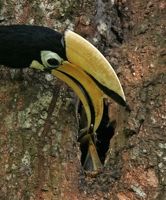

After 29 day of incubation and 2 months being sealed with the chicks, the female will reopens the cavity entrance and frees the young hornbills.
The parents will accompany their Chicks as they discover a whole new world.


However,  the Hornbill population decreases drastically due to hunting and deforestation over the decade.
If the male is hunted and died during the nesting period, then the female and chicks will eventually die too due to starvation.
One down then the whole family down..
So, please do not support any traiting of Hornbill product and help conserve this family "loving" creature!

If you are interested in birding, Tanjung Aru beach and the Prince Philips park beside the Tanjung Aru First Beach are  good places to start with.
There are Hornbills, Parrots, Kingfisher, Dollar Birds and many other birds which you can see it easily even without using a binocular.

So, this is my first post on Birds Fact!
Hope you guys will love it. :)
And Happy Birding!!!

Reference:
1. Kinnaird, M.F. & O'Brien, T. G. 2007. The ecology and conservation of Asian Hornbills: Farmers of the Forest. The University of Chicago Press: London.

2. Phillipps, Q. & Phillipps, K. 2011. Phillipps' Field Guide To The Birds of Borneo. John Beaufoy Publishing: London.


Thursday, 19 April 2012

Imbak Canyon: Into The Heart of Borneo Part 2- Frogs?!

Thank you for waiting patiently for my part 2 of Imbak Canyon adventure~
In this post, I would like to share about things that I done in Imbak Canyon.
As it's a Field Work, so means I did not go there for HOLIDAY..
But I go there to WORK....
Our class have been divided into 3 groups which were
 vertebrates, invertebrates( insects) and botany (plant).
I have chosen to be in vertebrates group as I will be taking Birds as my final year project.
P/s: Birds are group under vertebrates.


The vertebrates group~
We worked on Frog and small mammals.
There are only six of us in this group.
P/s: most of my coursemates chose to work on plants.
So, what we basically do in Imbak Canyon for Vertebrates group were frogging and small mammals trapping.
P/s: Frogging means catching frog.


In this post, I would like to talk about FROGGING.
Frogging usually carried out during the night time as frogs are active around 6.30-8.00pm.
What you need during frogging includes a torch light, head lamp, GPS ,a Moisture meter, a sling bag and soft transparent plastic bags.
Torch light and head light are essential in spotting a frog in the dark.
Frogs can be spotted by the reflection of their eyes from light of your torch light.

Moisture meter is used to detect the moisture of surrounding.

GPS is needed to track the location and altitude where the frog specimen found.

Soft transparent plastic bags are needed to keep our frog specimens.
We need to blow in air and tie a knot at the end of the plastic bag.
Rubber band and zipper lock plastic bag are not used in keeping the specimens as the large size frog may hop vigorously and release them selves from the zipper lock.
And at last a sling bag to keep all your specimens in it and Off we GO~
We have been frogging for two nights. 
It was raining for that two days.
We need to wear a rain coat to keep our selves dry.
P/s: actually it did not help much.. 
My hair still wet as the rain water soak through the rain coat..
Walking on a slippery and muddy trail in the night was a hardship...
Not to say that it was a hill trail that we needed to go up and down the slippery slopes...
And I fell down when  going down a slope..
My butt was super pain!!! >.<
But at the last night I manage to catch a small frog with my friend~
A great succes~ ^^


So, do you guys ever hold or catch a frog before?
The first thing that might come into your mind will be:
EWWW.... It's slimy and cold!!!
Yup... That's true...
They are slimy and cold blooded animals... 
It took me a very long time until I get brave enough to hold on a frog...
Not that I afraid of frog...
But holding them just seems to be... Yiaks.....

But at last I hold the first ever living frog on my hand..
Feel like I'm a super woman as I think many GUYS out there don't even dare to touch a frog~


During the day, we need to process the frogs and identified which species that they belong to.
We have to take out the frog and measure its Snout-vent length and weight. 
Then we do Exsitu- Indoor photography for our frogs.
Yes.. We do Indoor photography..
This is to prevent our frogs from escaping and taking photo in a field may not generate a good picture.


To take a photograph, firstly,  we need to set up a mini studio using black cotton clothes as background.
Then we have to find props such as leaves, sticks and stone to recreate the habitat of the frog.
P/s: Different species of frogs have different microhabitat.
So, we need to know the specific habitats of the species before we set up the props. 
And before we place our specimens onto our mini studio, we bath the frog with water to cool them down.
P/s: The photography should be carried out at some where cool and shady..
After placing it on the props, we quickly snap as many picture as we can!!!
P/s: The eyes are important in taking pictures of animals!
Remember to focus and minimize the background so that the Black clothes back group could not be seen in your photo~ 
P/s: I not a professional but just to share what I have learn during my field work~
Here are some photo that I took~


Here are some Things that you should be aware of while handling frog.
Always stay in front of the frog while catching frogs.
P/s: they can only hop to the front but not backwards!
Always hold a frog with their hind leg's joint.
P/s: Frogs jumps with their hind leg, by holding the joint it can prevent them from jumping away from you~
Always wash your hand before handling a frog as frog are sensitive to chemicals.
P/s: The chemicals on your hand might KILL them!
And also, wash your hand after touching a frog and before handling another frog.
This is due to some frogs may secrete poisonous chemical on their skin.
Even though it is harmless to human, it will eventually kill another frog!!
Always remember to blow in sufficient air and pour small amount of water into the plastic bags containing the frogs.
This is to ensure they are comfortable and do not die before you process them!!!
After the processing, we released the frogs back to the nature~
P/s: Usually researchers will kill the specimens and preserve them as sample.
However, Imbak Canyon is a conservation area that doesn't allow us to take any vertebrate sample.
So, the frog are SAFE!!!
P/s: I hate the killing too...
Please don't ask me why conservation biologist kill animals to take sample...
The animal won't gone extinct cause we kill few of it as research purpose.
But destruction of nature does!!!
 (Quoted from my lecture who doesn't want his name to be appeared in internet)
Keeping them as sample can aid in the research to preserve the forest and nature!!!
As our Conservation Biology Slogan:
We Care, We Love , We CONSERVE!!!

~My First time holding a living frog~
Stay tune for the Part 3 of Imbak Canyon Adventure~

Tuesday, 27 March 2012

Interesting Facts of Insects: ANTS.. Male? Female?


As a Conservation Biology student, I often encountered interesting facts bout animal , insects and plant in my course that really amazed me~
Things that you will never thought of it although they are always been there around you~
So, I decided to share my knowledge to you all~
Today I will talk about ANTS~


"Ants? What so special bout it?" you may ask this question..
But I can tell you that there are much that you actually do not know..
The question is:
Do you know that those worker ants ( those that go out searching for food) are male or female?
.
.
.
:
.
.
.
.
The answer is female ants!!!!

Then you wonder where does all the male ants go?
Actually male ants will just stay in the nest and wait for the right time to mate.
The female ants will provide food for them...
Weird right? 
In Chinese, they are said to be "eat soft rice" (吃软饭)
which means guys that rely on girls for living..
Xp

Then sometimes you see ants that have wings flying around the light after rain right?
And they will die on the floor within a week..
That's actually the male ants..
Only the male ants and Queen ants will poses wings to fly..

The male ants with wings

When it is the time, those workers ants will open a passage for the male ants to fly out from the nest and mate with the queens from different colonies.
After mated, the male ants will die as their duty have completed
while the queens will search for some where strategic to build their nest.
P/s: In one nest may have only one queen or few queens.

The Queen
Only queens are fertile to reproduce, other female ants/worker ants do not reproduce.
Queens only work as " reproduce machine" while
Worker ants search for food, look after for young and defend their nest.
P/s: There are actually more than 20,000 or more species of ants!!!

Interesting right?
Stay tune for more Interesting facts bout animals, insects and plants in my blog~

Thursday, 22 March 2012

Insect Phobialogy: The dissecting of grasshopper!

This semester I'm taking Entomology as one of my main course.
It's a NIGHTMARE...
I'm seriously phobia with insects...
Especially big and flying insects...
So, for the first lab of Entomology,
we are required to observed and drew the specimens.
Seriously, this was my first time to look at an insects that "close".

I'm super scare of Bee...
Luckily, they are dead specimens..
If  suddenly they become like " The Night In The Museum",
I sure scare DIE DIE lo...
But the hardest part is drawing...
We need to draw the insects...
Scientific drawing with scale...
Damn.. I hate DRAWING..
Make me STRESS!!!
The second lab was a disaster too.
We are required to catch 5 life insects each person for dissecting....
Catch INSECTS!!!! OH NO!!!!

This is my course mate's Giant Stick Insects.
Luckily with the help of my course mates,
I have my specimens at last.. 

First, we need to make it DEAD.
We place the specimen into a jar covered with tissue dropped with few drops of etylacetate. 
P/s: It's quite hard to place them into the jar actually.
They keep tried to escape.
Then, we wait till it dead.
P/s: So cruel watching them slowing weaken and dead..

Then, we placed the specimens on the dissecting board and pinned it to fix its position.
And, We start dissecting it.. 
However, my specimen was too small so we take quite some time to dissect it.
P/s: Poor Grasshopper as it didn't die completely when we dissected it..
It's antennae is still moving!!!!
Amitofo...

Stereoscope is needed to observed our specimen.
P/s: Really Too small!!!

Here  this is the larger version of the dissected specimens.
We can see the heart and its muscle clearly.
The black colour thing in the middle is the heart.
Above it is the lung and orange colour thing beside it is the wing muscle.
P/s: Before this I never thought of what's inside an Insect!!!
And.. we need to draw it... ==
Haiz... It's isn't over yet...
I just know that we have to collect 25 insect specimen for collection 
and we still have another Fisiology lab that we need to learn how to preserved insects..
Oh GOD....
I just hate Bugs...