Nuffnang

Showing posts with label Nature. Show all posts

Friday, 8 November 2013

Volunteer Life- MNS Hornbill Volunteer Programme

Did you ever imagine living a life without smart phone, internet, laptop, Tv and all the electrical devices?
Well, I  ditched away my smartphone, laptop and internet for 12 days and yet I still "ALIVE"!
Well, the story began with my internship with the Malaysian Nature Society (MNS) where I joined the MNS Hornbill Volunteer Program in Belum-Temengor Forest Complex.

P/s: That was Elephant poops~~
Belum Temengor Forest Complex is the second largest remaining block of unprotected rainforest in Peninsular Malaysia.
PS: It is approximately 130 million years old!!!!!

It is home to some of Asia’s most spectacular wildlife including tigers, elephants and rhinoceros, and something very special; possibly the world’s largest seasonal congregations of hornbills. 
P/s:  There are 10 species of Hornbill in Malaysia and all 10 of them can be found HERE!!!

During my internship with the Malaysian Nature Society, I joined this volunteer programme in the Belum –Temengor Forest Complex, Perak for 12 days.
 We were here to monitor the Plain-pouched Hornbill as a part of a national conservation effort where we help to conduct important daily flight census and collecting data.

To get into the Belum-Temengor Complex, we need to travel to Gerik town, Perak  and from Gerik to Banding Jetty. 
The Jetty is located below the bridge of East-West Highway.
Then from Banding Jetty, we traveled into the Kampung Tebang, Belum Temengor by boat.


The forest is flooded into a manmade lake for dam water supply.

We settled down in the bamboo hut built by Orang Asli just beside the Temengor lake. 


Breath taking scenery from the hut~


My bed.. Well... It was a volunteer program so we just slept on our sleeping bed...

Our food supplies for a week~


 Hornbill census was conducted twice a day, once in the morning and once in the late afternoon. 
This valuable information on population numbers will be used to advocate for the protection of Belum-Temengor, especially in addressing the logging threats.

Bird counting even during raining days...
Everyone in the counting group was ready with their binoculars at the birding site and waited for the Plain-pouched to come.
After a helicopter sound like was heard, Oh My God!!! It's the Plain-pounced flying above us!
The Helicopter sound was actually the flapping sound of their wings.
It was so amazing!!!!
Wait a minute, Don't Just Stand There!!! Quickly start counting!!!
Flock 1- 1,2,3,4,5,67...
Flock 2- 1,2,3,4,5,6,7,8...
My eyes get blur when so many of them flew together... @.@
But after some practice, you will get use to it and bacome good in counting too~


Say hello to Plain-pouched Hornbill~~
You can clearly see the colour of their pouch where blue is female while yellow is male~
P/s: This is a globally threatened bird where you can't see it in Borneo.

The most incredible scene of all was when hundreds of Plain-pouched  Hornbill flew across the sky in V or U shape formation.

Beside counting, we also have activities during our free time.
We hiked around for birding, experiencing the Orang Asli life, and did some social work with them.


This Orang Asli lady demonstrated the traditional way in preparing Orang Asli dishes.


And she has a Rooster that act like dog!!!
The rooster in Kg Tebang will " crow" fiercely when strangers come near their owner's house!!!
And they can fly up to the tree tops and roof top to crow during the sunrise...
Then you will know there are how many of them actually around Temengor when all of them take turn to crow... @.@

Paip blowing demonstration by Orang Asli.
They claimed that there are no cure for the poison that applied on the dart..
So, becareful while handling!


Well, my favourite activity during my leisure time was "spying" on the life of Orang Asli~
Their kids were shy but they really have a different lifestyle from city kids.

They were free to play at all time and made themselves dirty all time.
This is what the city kids are not allowed to do...

We have to carry water from the lake up into the house for daily usage...
@.@

Too bad that I didn't manage to see the blooming Rafflesia... The flower was still in bud form.. 


Lastly, I really did enjoy the life living around the Orang Asli!
I got my chance in trying many new things here such as fishing, washing beside the lake and bathing beside the lake too!
But the best thing of all was enjoying the silent night with fireflies dancing around the lake under the starry night~
This is the magical moment that we will never experience in the city....

Planning to do something meaningful while having holiday?
Why not try enrolling yourself in a volunteering programme?
Why not enhancing your life experience while lending a hand in helping our mother earth?

Sunday, 13 January 2013

Birds of Borneo: Oriental Pied Hornbill


Have you ever seen a wild Hornbill with your own eyes before?
Not through TV or in Zoo but in the Wild?
For sure you will think that where the heck am I going to look for Hornbill since they live in the forest....
Well, good news is  hornbills actually do live in URBAN area too!!!
Today I would like to talk about a Hornbill that can be found on islands and in coastal area- the Oriental Pied Hornbill, Anthracoceros albirostris.


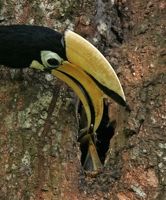
Oriental Pied Hornbill is distingiush from other hornbills with its black marks on their white bill of both sexes and their white belly.
So, next time when you saw a hornbill with black marks on their white bill, you can proudly tell your friends that that is an Oriental Pied Hornbill! xp


Where can you found them?
If you living in Kota Kinabalu, or you are visiting Kota Kinabalu, you don't really have to go into the wild or forest just to look for them!
You can just visit the Tanjung Aru First Beach and you can see them flying above your head or standing on a tree just on top of you.
Yup!!!! It's the place where locals and tourist like to hang out and have meal!!!!
But to pay them a visit, I recommend to visit them during the morning, best before 10am where there are less crowded along the beach with less human disturbance.


An Oriental Hornbill perching on the wall beside the food stalls at Tanjung Aru beach.


A female and male Oriental Hornbill perching on the Lamp post.
How to differentiate between male and female Oriental Hornbill?
Well, it is quite easy~
Male has larger "horn" while female has smaller "horn" and has red or brownish marks at their lower bill which is absent in male.
Well, the male have black mark only on the horn, while the female have black marks on both the horn and on the bills too.
So, the left hornbill in the picture is the female while the right one is the male.
Hornbills are actually very loyal towards their mating couple.
Male Hornbills can be said as "Family" concentrated bird.
Why do I said so?
This is because the female will be sealed inside a cavity with her feather shed away after she lay her eggs!
She has to depend mainly on the male to feed her and her chicks to survive as she can't fly during  the nesting period!
This proves that Male Horbills are very loyal as they won't abandon their mate and chicks.

Before mating, Oriental Pied Hornbill will carry out courtship feeding and in the search for a suitable nesting cavity.
The male oriental pied hornbill will lure the female hornbill into the nesting cavity and he needs to convince the female that he is capable of feeding her once she is sealed in the cavity.
He will demonstrate to feed at the cavity or placing food inside.
Once the female is convinced, she will fly in and clean the interior of the cavity.
Then the birds will mate.
After that, the female will the sealed inside the cavity with mud and feces living only a narrow opening for the male to pass the food to her.
She will then lay her eggs and shed her feathers.
The sealing of female inside the cavity is one of the strategy to prevent from predators, prevent the cavity from flood of water and keep out competitor which may take over the nest (Kinnarid & O'Brien, 2007).


After 29 day of incubation and 2 months being sealed with the chicks, the female will reopens the cavity entrance and frees the young hornbills.
The parents will accompany their Chicks as they discover a whole new world.


However,  the Hornbill population decreases drastically due to hunting and deforestation over the decade.
If the male is hunted and died during the nesting period, then the female and chicks will eventually die too due to starvation.
One down then the whole family down..
So, please do not support any traiting of Hornbill product and help conserve this family "loving" creature!

If you are interested in birding, Tanjung Aru beach and the Prince Philips park beside the Tanjung Aru First Beach are  good places to start with.
There are Hornbills, Parrots, Kingfisher, Dollar Birds and many other birds which you can see it easily even without using a binocular.

So, this is my first post on Birds Fact!
Hope you guys will love it. :)
And Happy Birding!!!

Reference:
1. Kinnaird, M.F. & O'Brien, T. G. 2007. The ecology and conservation of Asian Hornbills: Farmers of the Forest. The University of Chicago Press: London.

2. Phillipps, Q. & Phillipps, K. 2011. Phillipps' Field Guide To The Birds of Borneo. John Beaufoy Publishing: London.


Thursday, 11 October 2012

Kinabalu Wetland Centre.. Final Year Project Started!!

When you saw this picture, you might wonder... 
what is this girl looking at ah?
Yup! That's me doing my Final Year Project (FYP)..
I'm looking at birds actually~
As I mention before I working on Urban birds diversity for my thesis..
However, when others know about their title, their first reaction were:
"Birds? Looking at bird for what?"
The situation get worst when I brought my binoculars to my neighborhood's park to look for birds..
People are looking at my as a weirdo and laugh at me.... T.T
May be public are not familiar with bird watching yet...
But if you go to Tanjung Aru beach or KK wetland, then you may meet with some bird watcher and birds photographer looking for birds too~

So, if you saw me walking and looking around with a binocular..

Chill la.... I doing my thesis on birds la....


Actually I'm comparing the bird diversity in KK wetlands, Tanjung aru beach, Bukit Padang park and Kingfisher park~
So, my first stop will be KK wetlands~ 
I think many UMS students don't even know where is KK wetlands ba..
Actually it is very near to UMS...
It was located near the Likas Stadium~


So this is the office where you need to buy your tickets to enter the wetland.
For Malaysian student, the fee is RM3 only~ 
and you need to give a deposit of RM2 for the entree pass.. (They will give it back to you when you return the pass)
Cheap right? It is for the conservation fee~


It was a super sunny morning when I arrived there around 8.30am.. 
We were the first visitor of the day!!!

This is the list of birds that you can find in KK wetland..
But don't expect that you manage to watch them all just in one visit..
Birds are good in hiding themselves..
So, be quite when you are there~


KK wetlands is one of the mangrove forest that is located in Kota Kinabalu..
It is also a tourist destination in Kota Kinabalu.

This is a spot for Ergret (bangau)  and heron nesting sites~


If you think beaches like Tanjung Aru is too crowded,
KK wetland will be an ideal place for you to have a short run away as it is very near and quite too~


Special thanks to Wei Ping for wake up SUPER early in the morning and accompany me to do my FYP~


Besides that, also special thanks to my course mates, Hidayah, Florina and Rafiq for coming to KK wetland during noon too~


Us pretending as tourist~
KK wetland is not only a great place for bird watching, they also organize Environment education program
 such as tree planting and tour for students and visitor too..
They also have exhibition room in their office too~


If you are planning to visit the KK wetland, there are some tips for you:

This is a sign board of what can't be done here...
No high heels definiently... If you love your high heel..
Or else your heel will be stuck in the gap or mud...

Sport shoe is the best~

Wear a long pants and long sleeve if you don't wan kisses from the "lovely" mosquito ~
And this is the consequences of wearing a shorts here...
Pity for Wei ping's leg~

Don't wear colourful clothes if you wan to watch birds here..
As vivid colour will scare them away..
Wear something that can blend in the environment well~
And no perfume too...
Birds can smell actually~ 

You can rent a binocular from the counter for RM5 from the counter..
So that you can see the colour and the uniqueness of every birds clearly~

For bird watching, besides a binocular,
you also need to have at least one guide book so that you know what is the bird that you found.
For Sabah or Borneo area, you can use Phillip's guide of Birds of Borneo ( the white book).
For Malaysia and Singapore, you can use A Naturalist's Guide to Birds of Malaysia and Singapore ( the green book).
For me, I use both of them for my references of FYP~
For photography session, I recommend to visit KK wetland around 8am in the morning as the lighting is good for photography..
To search for birds, you can visit here for 2 times which is 8am in the morning and after 4pm in the noon as birds come out during morning and before sunset.
Here are some updates of some photography by me in KK wetland.

Great Egret ( Yellow Beak) and Little Egret ( Black Beak)

Do you see the love? 

Little Heron

The ant saying Hi to the Butterfly~~


With all the tips, hope you can enjoy the view and nature of KK wetland~ 


Visiting Hours
Tuesday - Sunday: 8am - 6pm
Closed on Mondays except public holidays

Kota Kinabalu Wetland Centre

Off Jalan Bukit Bendera Upper,
88400 Likas, Kota Kinabalu,
Sabah, Malaysia.
Tel: 6088 246 955 Fax: 6088 247 955
You can see the Map here~